
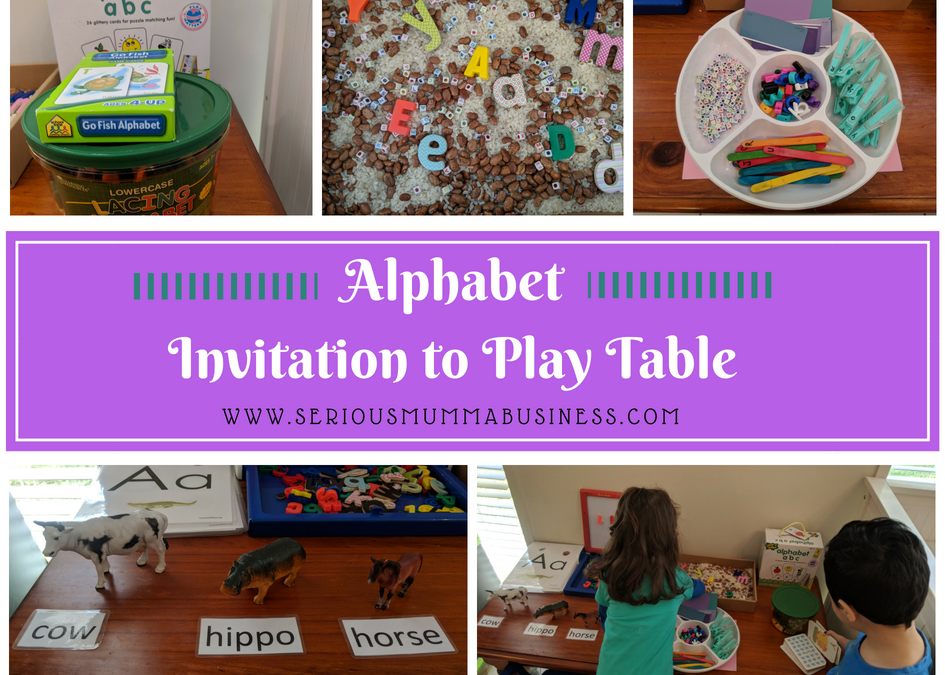
Now, the first question you might be asking yourself is…. What the heck is an Invitation to Play Table?
The second question might be… Why is it important to do this for my child?
Well, there are loads of answers for the second question, so I’ll start with the first.
What is an Invitation to Play Table?
An “Invitation to Play” Table, is a table that is set out ahead of time with different toys, objects, sensory elements and/or learning resources. It invites, or encourages your child to play in a way that is meaningful for them.

In an ideal world your Invitation to Play table will:
- be based around a theme that interests your child
- incorporate opportunities for open-ended play
- change on a regular basis (I would recommend once a week, particularly if you offer extensions)
When I set up our play/living area, I included an old coffee table, and 2 plastic chairs so that I had the foundation for my Invitation to Play table. It’s at the perfect height for my kids to be sitting comfortably and with a sense of postural control.
Then (pretty much) on a weekly basis, I update this table with a theme that has come out of an interest they have recently shown. Lately, Mr 4 has shown an interest in his name and letters again. We definitely go through stages of enjoying letters / alphabet play, and times where they have very limited interest. By tuning into what your kids are interested in, you will have a better chance of connecting with them, and also for them to retain any learning.

By collating different learning resources, adding a related sensory box, and incorporating ways to play with everyday objects, I managed to create an Invitation to Play table that holds their interest
Sensory boxes or sensory trays that you include as part of an Invitation to Play table do not need to be complicated. Something as simple as the one I created here has already been used in a couple of different ways: matching Capitals with lowercase letters, letter hide and seek, and just running our hands through the texture for a calming/thinking effect.

I combined pinto beans and white rice as the base. I deliberately didn’t colour the rice as I wanted a neutral background for the colourful letters to stand out. I added in some magnetic capital letters, lowercase letters and some small alphabet beads.
It was a no-brainer for me to include some alphabet related educational resources I already had on hand.

An alphabet puzzle helps them with alphabetical order as well as matching upper and lowercase letters; Go Fish is a game I have recently taught them so I knew they could even play this on their own; Alphabet lacing allows them to use their fine motor skills, and create lovely necklaces.
I also included some laminated letters that I have previously used. I’m interested to see how they use them, but I have a few ideas myself of how to incorporate these when I play with them.

An old magnetic whiteboard toy gives them the opportunity to create their own words with magnetic alphabet pieces
I’m a big fan of using everyday objects and basic craft supplies. These can be corralled together in a divided tray:

Everything in this tray was something I had on hand. You don’t have to spend huge amounts of money for your children to have fun and learn!

I wrote letters on the top of craft sticks thinking they could create their names, or other words

Pegs are such a great tool to strengthen little hands and help prepare them for all the writing they will eventually do. As they’re very focused on their names at the moment, I wrote their names on some paint chip cardboard and they can match the pegs to their names

These tiny alphabet beads offer a creative way for them to practise their pincer grasp, hand-eye coordination and give you ways to reinforce letters and colours
I usually take advantage of the fact that they go to kindy a couple of days a week, and update the Invitation to Play table then. If I don’t get to it then, I like to do it after they’re in bed so it’s a surprise that they come downstairs to.

As soon as they arrived home they rushed over to see the new setup. Of course, Miss 4 went straight for the sensory tray, while Mr 4 went straight for the card game

Developing good bi-lateral coordination

This activity allows them to strengthen the muscles needed for dressing themselves

It also provides an opportunity for concentration and improving attention

Yet another opportunity to work on bi-lateral coordination, fine motor skills and strength, but by offering it in a fun way that seems like play, you get a lot less resistance!

And it’s a great way to reinforce the spelling of their name!

There are so many benefits to a simple card game! Executive Function really kicks in here, so be mindful of being on hand to offer assistance if you have a child that struggles with this to avoid unnecessary frustration and encourage persistence

Again, so many developmental blocks are strengthened by simply completing a puzzle
I also like to stretch my kids as this is an important part of their development and growth. In order to do that this time, I incorporated some laminated words spelling out some of their favourite animals. This gives them an opportunity to see how words look different, related to the sound, and it encourages them to create words themselves.

After copying these words with their magnets, you might like to encourage your child to put pen to paper or ask them other words that they would like you to spell and for them to re-create
My hope is that by detailing some of the activities on this Invitation to Play table you will have already started to develop a sense of why these are a valuable tool to have in your parenting back pocket. Let me add a few things to also consider.
Why are Invitation to Play Tables Important?
Here is just a short list of why I feel they are so important:
- By focusing on something the child is interested in, it improves their engagement and retention of learning
- It offers multiple ways for children to be creative. Sometimes I’m surprised by the ideas they come up with on how to play with the objects on offer
- It’s a fun way to get in some therapy, without the tears or fights. Think about what skills you would like your children to work on and offer ways for them to play in that manner.
- By rotating it gives them an opportunity to focus on what’s on hand without being overwhelmed with too much choice
- It encourages them to play independently
- It can work for children of multiple ages and developmental levels. Children can play in parallel or cooperatively
- Mum or dad can join in the fun and, best of all, play with them at their level


Recent Comments